University of Helsinki
IALIC 2018, Helsinki
IALIC 2018
The ‘good’ interculturalist yesterday, today and tomorrow:
Everyday life-theory-research-policy-practice
29-31.8.2018
Faculty of Educational Sciences, University of Helsinki, Finland
Organised by the TENSION research group (Director: Fred Dervin)
Ashley Simpson’s viva
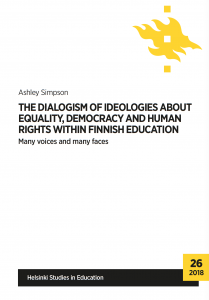
Ashley Simpson: The dialogism of ideologies about equality, democracy and human rights within Finnish education
Professor Leena Robertson, will serve as opponent, and Professor Fred Dervin as the custos.
The dissertation is published in the series Helsinki Studies in Education, number 26.
The dissertation is also available in electronic form through the E-thesis service.
Welcome! And congratulations to Ashley!
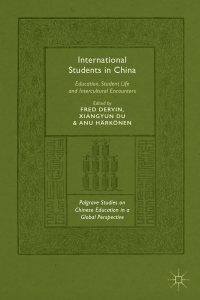
New book: International Students In China
New article
Truths, Omissions and Illusions in the Era of Marketization
Chinese University Leaders’ Perceptions of Finnish Education
Xin Xing Fred Dervin Pingjun Fan
Journal of the European Higher Education Area

Helsinki summer school course
Interculturality in a New Global World: China’s One Belt, One Road as an Example
Organiser:
Faculty of Educational Sciences, TENSION research group (diversities and interculturality in education), University of Helsinki
Dates:
7.8.-23.8.2018
Credits:
6 ECTS
Coordinator:
Dr Fred Dervin, University of Helsinki
Doctoral candidate Yongjian Li, University of Helsinki
Doctoral candiate Haiqin Liu, University of Helsinki

Target students
Bachelor’s and Master’s levels. Students who have an interest in intercultural studies, intercultural / multicultural education and social justice, but also sociology and anthropology. No background in intercultural studies or Chinese language needed.
Synopsis
The world is changing dramatically, and we need new ways of explaining and understanding what is happening when people meet across borders (national, regional, cultural, linguistic borders, etc.).
In the first part of this exciting course, new critical perspectives from the fields of multicultural / intercultural communication and education are proposed. Basic concepts such as culture, globalisation, identity and diversity are introduced and critically reviewed.
The originality comes from using China to illustrate the second part of the course. The One Belt, One Road Initiative, which promotes connectivity and cooperation between different continents, is a great example of today’s new global world. The initiative aims to support infrastructure networks, as well as cultural and educational collaboration. This example is best suited to work on today’s interculturality.
Working together and with the lecturers, the participants will analyse different documents about the initiative and discuss what interculturality is and what it entails. The participants will learn to transfer the acquired knowledge and methods related to interculturality to other contexts.
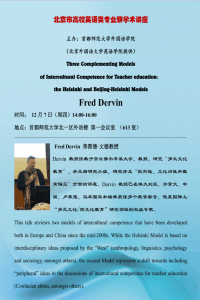
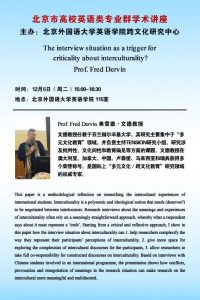
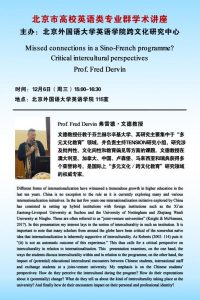
Talks at BFSU and CNU – Dec. 2017
New issue of IJBIDE
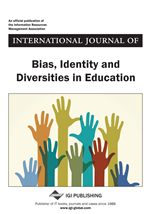
Abstract Announcement for International Journal of Bias, Identity and Diversities in Education (IJBIDE) 3(1)
Special Issue on Developing Language Awareness Through a Pluralistic Approach: The Case of the Baltic and Nordic Countries
The contents of the latest issue of:
International Journal of Bias, Identity and Diversities in Education (IJBIDE)
Volume 3, Issue 1, January – June 2018
Published: Semi-Annually in Print and Electronically
ISSN: 2379-7363; EISSN: 2379-7355;
Published by IGI Global Publishing, Hershey, USA
Editor-in-Chief: Fred Dervin (University of Helsinki, Finland), Julie Byrd Clark (Western University, Canada) and Yongjian Li (Renmin University of China, China and University of Helsinki, Finland)
https://www.igi-global.com/journals/abstract-announcement/185420
Read the EDITORIAL (DERVIN/LI)
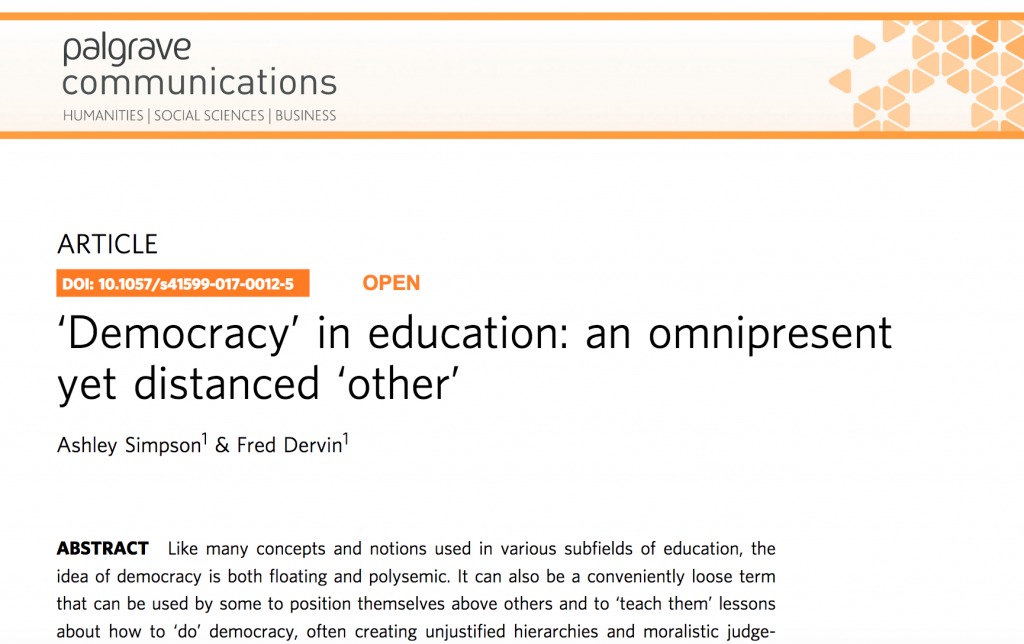
New article
Brown Bag seminar in Singapore